


Low back pain most often occurs due to degenerative and dystrophic changes in the spine.The intervertebral disc is injured when lifting heavy objects, excessive load at rest and during movement, falls.The protrusion of the fibrous ring through tears and fissures in the nucleus pulposus forms a hernia.Instability in the spine contributes to the development of osteophytes (spondylosis), damage to intervertebral joints and ligaments (spondyloarthrosis), osteochondrosis, which is accompanied by pathological processes in the sacroiliac joints.
In addition to compression changes, pain is caused by reflex irritation of receptors, the impulse of which goes to the motor neurons of the spinal cord.Muscle tone increases and over time pathologies appear in the muscle tissue.Back pain can result from the appearance of tumors, multiple myeloma and systemic autoimmune diseases.
Causes of pain and its types
Pain sensations can be dull, sharp, aching, burning and throbbing.They can spread along entire coasts, radiate into neighboring areas, or be local in nature.An unpleasant feeling develops in different ways;It may appear suddenly or increase over a long period of time.
The symptom is also classified according to the cause of its occurrence:
- primary pain is a consequence of degeneration of the musculoskeletal system, injuries to it;
- the secondary type occurs during pathological processes in the body not related to the lower back.
There are two types of pain:
- Periodic are characteristic of great physical exertion, acute illnesses and physiological characteristics;they may radiate to another part of the body or spread beyond the affected area.After eliminating the cause of their occurrence, they stop bothering the person.
- Constant pain is a consequence of deep damage to joints, tissues and muscles.With the help of medication, the symptoms are temporarily eliminated, but they reappear.
Indications for advanced diagnostics
To determine the pain relief method, it is necessary to carry out additional tests to identify the true cause of the syndrome.Tests should be done if:
- atypical manifestation of pain (no increase or decrease in discomfort when moving the body), unusual location (for example, discomfort radiates from the back to the perineum, abdomen, rectum, anus, vagina);
- weakening of symptoms while standing and pumping while lying down;
- changes in the nature of back pain related to going to the bathroom, eating, having sex;
- previous injuries to the spine or hip joints;
- pain accompanied by vomiting and high body temperature;
- diagnosed oncology;
- the presence of mental behavioral disorders.
Additional studies are carried out in a hospital environment, when the patient is admitted to neurology or other services that have a laboratory for diagnosing the suspected disease.
An x-ray of the spine is taken in several projections, a general blood test is taken and an advanced biochemical analysis is performed, which shows the level of creatinine, calcium, glucose, phosphates and other substances in the blood.The computer and MRI diagnostic method is widely used.Bone scintigraphy is used to examine bone tissue.
Diseases of the musculoskeletal system
Unpleasant sensations in the back occur due to the following reasons:
- Intervertebral osteochondrosis includes several types of pathologies characterized by dystrophy or degeneration.Due to the disease, articular cartilage and bones are loosened and destroyed, and nerve endings are involved in the pathological change.Osteochondrosis provokes the development of hernia, lumbar radiculitis, sciatica, protrusion (bulging of the intervertebral disc without rupture of the fibrous ring).
- Scoliosis is a curvature of the spine, with an asymmetrical shoulder line.It is accompanied by skeletal deformation, poor posture and protrusion of the hump to the right or left into the intercostal space.Classified as congenital or acquired form.
- Spondylosis occurs due to the natural aging of the vertebrae and joints in the lower back;Over time, pain increases as joints wear out and mobility is lost.
- Low back pain is characterized by acute discomfort in the lower back due to destructive disorders in the vertebrae.Pain occurs when lifting weights incorrectly and is more common in men.In low back pain, movement in the lower back is limited;lack of treatment is dangerous, as destructive processes turn into an irreversible stage.
- Ankylosing spondylitis (Bechterew's disease) is characterized by loss of mobility of the lumbar joints and is a chronic inflammation with significant proliferation of connective tissue.
- Osteomyelitis is a purulent necrotic inflammation of the bone marrow, bones and surrounding soft tissues.The disease occurs due to infection by purulent mycobacteria and pyogenic (pus-producing) bacteria.
- Osteoporosis is formed as a result of inadequate development of bone tissue due to impaired supply of phosphorus and calcium, while bone density is reduced, which leads to frequent damage.
- Congenital or acquired difference in leg length (more than 3 cm).
These diseases require a visit to the clinic for examination and serious treatment.Sometimes therapy helps to alleviate symptoms only for a while, and for a complete cure, a surgical method is used.
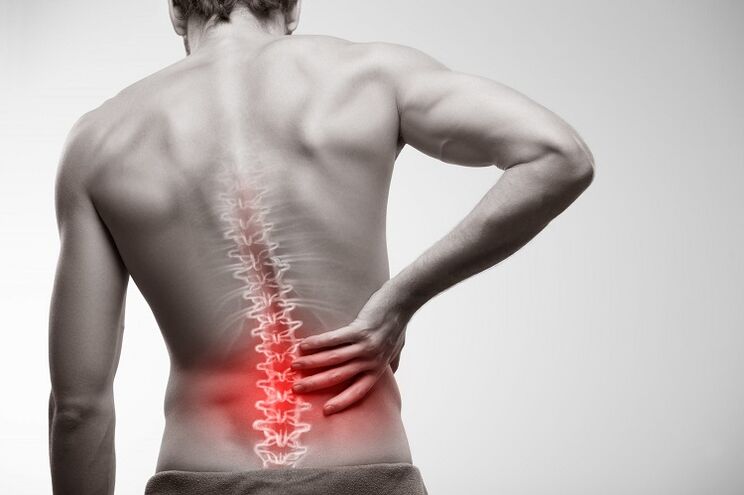
Kidney pathologies
Due to impaired kidney function, discomfort in the lower back and pain in the left, right, and sometimes in the middle of the back may occur.The causes of the symptom may be the following pathologies:
- Kidney prolapse.This is a condition in which the organ moves beyond the permissible norm (the displacement of the renal bed is provided down and up by 2 cm).In nephroptosis, the kidney is called wandering if it can deviate by 10 cm.
- Kidney failure is a condition in which urine is not formed.The patient notes that he feels a sharp pain in his lower back and that his health is rapidly deteriorating.
- Pyelonephritis is an inflammation of the renal pelvis and nearby tissues of the genitourinary system are involved.With this disease, urinary diversion may not be impaired and pain in the lower back on the right and left is due to the intensity of the inflammatory process.
- Gout causes discomfort when rising from a sitting position or during other movements.When the disease occurs, the natural uric acid metabolism is disturbed;accumulates in the lumbar joints, limiting their mobility.
- Renal colic is a common pathology.With it, pain occurs for various reasons.The most common are damage to the ureter due to calculus, torsion or obstruction of the upper urinary tract due to a blood clot, pus or mucus formation.Low back pain caused by renal colic is characterized by an acute onset at any time of the day, during movement or at rest.
- Diabetic nephropathy is more typical in people with diabetes (75%) and is a complex lesion of the renal arteries, glomeruli and tubules as a result of changes in carbohydrate and lipid metabolism in renal tissues.Pain in this pathology radiates to any part of the back, as well as to the groin and lower abdomen.
- Glomerulonephritis is an inflammation of the glomeruli (kidney glomeruli) and can lead to kidney failure.A rapidly progressive and chronic form is observed.
- Kidney stone disease is not always accompanied by pain in the lower back;It can be difficult to determine its location.
- Hydronephrosis is characterized by dilation of the renal pelvis and discomfort.Requires additional diagnostics.
Gynecological diseases
Pain syndrome occurs in women due to diseases:
- The frequent location of discomfort due to uterine fibroids, vulvitis, adnexitis and neoplasms of the genital organs is the lower abdomen, but pain can occur in the lower back on the left and right.
- During pregnancy, the lower back hurts and it hurts to walk, but these symptoms arise for natural reasons and are explained by the load of the growing fetus on the musculoskeletal system, therefore they do not require treatment.
- Menopause is accompanied by pain due to impaired blood supply to the internal organs of the small pelvis, which, in turn, is a consequence of hormonal imbalance during this period.
- Unpleasant sensations can constantly arise due to psychosomatics.In this case, the woman needs to consult a psychotherapist and psychologist.
- The consequences of surgery, for example, abortion, can be accompanied by discomfort in the lower abdomen and spread to the lumbar vertebrae due to involuntary contractions of the uterus or the development of inflammation.
- Hormonal disturbances during the menstrual cycle, the release of the follicle from the ovary and its movement through the fallopian tubes, and the enlargement of the uterus during menstruation provoke pain in the lower back and lower back.
Other causes of low back pain
Discomfort in the lower back can be caused by diseases of the human body systems:
- Rheumatoid arthritis is a systemic pathology and most frequently affects women.This is a chronic inflammation that develops in the lumbar joints and involves nearby cartilage and muscles.The disease occurs due to autoimmune disorders in the body.
- Thrombophlebitis and phlebothrombosis develop due to partial or complete disruption of blood flow in deep veins.Discomfort in the lower back is felt after long walks or standing.This pain radiates to the buttocks and legs.
- Atherosclerosis in the last stage causes discomfort in the lower back.
Treatment of pain due to musculoskeletal problems
To eliminate discomfort in the lower back caused by impaired functionality of the musculoskeletal system, various medications are used, depending on the root cause and stage of the underlying disease.
They are used in a variety of forms, from tablets to intramuscular injections.
Nonsteroidal anti-inflammatory drugs (NSAIDs)
Nonsteroidal anti-inflammatory drugs are used to reduce pain.These medications reduce body temperature, relieve inflammation and fever.
NSAIDs from the phenylacetic acid derivatives group are popular in the treatment of low back pain.These medications are safe and effective and have an advantage over other analgesics, as they do not negatively affect the metabolic processes of the intervertebral disc.The therapeutic dosage, sufficient to alleviate severe discomfort, varies from 75 to 150 mg per day, with the norm being consumed in several doses.To accelerate the analgesic effect, rectal suppositories are used or the medicine is administered intramuscularly.
Muscle relaxants
If NSAIDs do not provide a positive effect in treating pain, muscle relaxants will be used.These drugs reduce the tone of skeletal muscles and reduce their movement - sometimes until the complete cessation of function.Start therapy with a standard dose and maintain it for several weeks.Practice shows that the addition of muscle relaxants to the complex pain treatment provides a lasting regression of discomfort and improves joint mobility.Combinations of different types of these medicines are not used.

Analgesics and corticosteroids
To relieve back pain, if it is very painful, narcotic analgesics are used, which have long been relevant in medicine.They are based on opioids, thanks to which medications provide relief.These medicines are prescribed by a doctor (they are sold in pharmacies only with a prescription);you cannot treat pain with these medications alone.
To eliminate the syndrome, corticosteroids are used in case of degenerative diseases in the joint tissues.
Medications partially restore the cartilage and prevent further destruction.
Injections
Injections are used if previous medications have not had the desired effect.For direct blockade in the lumbar region, drugs from the ester group and the amide series are used.
Blocking is a procedure to relieve muscle spasms at the site of pain;injections are administered into the nerve plexuses, including the paravertebral region, through a catheter.Its effect is short-lived, but it helps to alleviate severe attacks.
Use of ointments, creams and patches
With the help of gels and creams, discomfort is also eliminated.They are applied directly to the painful area.You can use NSAID-based products.Combined products have a more enhanced effect.
For the purpose of distraction and local irritation, warming ointments with a restorative chondroprotective effect are used, which dilate blood vessels, resulting in better nutrition of vertebral and cartilaginous tissues and accelerated metabolic processes in them.
The use of patches is popular due to the convenient method of application and fast action.The product is impregnated with the medicine and applied to the site of pain.With this method, overdose is excluded.
Other methods of influencing painful areas
Physiotherapy treatment allows you to warm up the muscles, improve blood supply and enhance the therapeutic effect of basic medicines.
Paraffin applications are used, which are effective in case of acute pain.The procedure consists of applying layer by layer of wax or paraffin to the skin with a total thickness of 1 cm, which is covered with polyethylene and then with a hot blanket.The duration is at least an hour, with daily use the course of treatment is a month.Physical therapy is effective when used during periods of non-exacerbated illness.Exercise also reduces the risk of recurring back pain.
Massage is not done in all cases, as in some pathologies it can harm the body.In this case, the effect does not occur on the painful area, but on the surrounding areas.The procedure must be performed by an experienced massage therapist;you shouldn't do it alone.
The mud therapy method is also used as a distraction.
Pain relief for gynecological problems
Complex antibacterial agents are used to eliminate the original cause of pain.Special medicines are used to reduce bacteriological infection of the vagina.An ointment containing antibiotics and antiseptics is used on the vulva region.
Inflammation of the glands of an infectious nature, accompanied by back pain, is treated with antibiotics, taking into account the sensitivity of the microorganism, and ultrawaves are used as a physiotherapeutic effect.Abscesses of the genital organs, in particular the Bartholin gland abscess, are surgically eliminated by opening.If the pain is moderate and the tumor does not bother the patient, hormonal medications are prescribed, considered only as prophylaxis before surgery.
GnRH antagonists reduce the amount of estrogen in the body.They are used for uterine fibroids, hyperplasia and endometriosis.Hormonal medications are effective as a means of reducing the size of the uterus before surgery.However, its long-term use leads to the development of osteoporosis.
In some cases, after treatment, the nodules begin to grow and cause back pain.Unpleasant sensations are relieved with the help of oral contraceptives.To alleviate well-being when low back pain occurs, Antigonadotropin therapy is used.These medications have many side effects, which is why they are used in rare cases.
If the growth of a tumor causes severe pain and threatens your health, surgery will be needed to remove it.During menopause and if a woman does not plan to have a child, complete removal of the uterus is recommended.In other cases, only the fibroid is removed laparoscopically (through small incisions in the abdomen).
Popular hormonal medications are NSAIDs.Antispasmodic medications are also used.

Help with kidney pain
Acute kidney pain is relieved with the use of antispasmodic medications that can widen the lumen of the ureter and ensure urine separation.
Acute symptoms require the use of combined analgesic and antispasmodic medications with anti-inflammatory components.You can take 2 tablets at a time;in severe cases, intramuscular injections are given.Analgin-based antipyretics help relieve kidney pain.
Traditional treatment methods
Traditional recipes help to relieve pain in the lower back, but before using them, you need to make sure that there are no diseases dangerous to human life and health that require timely drug treatment or even surgery.The most popular methods:
- A towel soaked in a combined infusion of St. John's wort, thyme, chamomile flowers and black elderberry is applied to the sore spot.For cooking, take 1 tsp.raw or dry raw materials, pour a glass of boiling water and leave for half an hour.Then remove the compress and go to bed.
- Garlic ointment helps a lot.To prepare it, take a head, grind it in an accessible way and mix it with a small portion of petroleum jelly and lemon juice.Apply the prepared mixture to the sore spot on your back.
- Mustard bath relieves pain.To do this, take a glass of mustard powder and pour it into warm water.Take a shower until it cools down, then rinse your skin with clean water and cover with a blanket.
- A compress of honey and vinegar (1 tablespoon each) relieves pain.The resulting mixture is placed on a cabbage leaf and applied to the problem area.
- Radish or horseradish are grated, combined with sour cream and placed on a napkin made of natural material.The compress is fixed with a scarf or warm scarf.
- Dry leaves of large burdock steamed with boiling water are applied to the sore spot and isolated.
- To improve blood flow in tissues, rub your back with honey.The massage is performed without pressure, but the movements must be intense.Similarly, use an alcohol tincture with eucalyptus, which can be purchased at the pharmacy.
- Make a compress from grated beetroot, squeeze the mass and mix the resulting vegetable cake with 1 liter.kerosene.With a napkin, the composition is transferred to the wound and fixed and wrapped.This compress is left overnight.
- Use grated laundry soap together with white incense, mix in equal amounts, add 2 beaten egg yolks.The product is applied to the back, a napkin is placed on top and secured with a bandage.Keep it for about 2-3 hours.
Back pain is treated by various means, but it is always necessary to diagnose the underlying disease that causes unpleasant symptoms.